
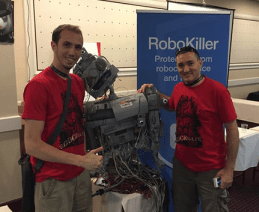
Contest Winners Ethan Garr and Bryan Moyles at DEF CON 23 from FTC’s website
Why aren’t telecom companies giving us the tools we need to block robocalls?
For the past two years the FTC held contests at the international DEF CON conference, the worlds largest annual hacker’s convention held in Las Vegas, awarding prizes for the best and most effective tools to fight robocalls. According to the FTC, last year the contest titled Zapping Rachel, named for one of the most prolific robocalls in the country, the familiar “Rachel from card services,” was a big success:
Zapping Rachel marks the latest step in the FTC’s ongoing campaign to combat illegal, pre-recorded telemarketing calls known as robocalls. The contest challenged participants to design a robocall honeypot which is an information system designed to attract robocallers, and help law enforcement authorities, researchers, and others gain enhanced insights into robocallers’ tactics.
Three hackers were awarded prizes for their creations help officials capture these robocallers.
This year at the 2015 DEF CON 23 hackers were awarded prizes for creations that include programs that can be used by consumers. From the FTC’s website:
Today, the FTC announced the results of the contest. Ethan Garr and Bryan Moyles will receive the top prize of $25,000 for their solution, RoboKiller, which relies on call forwarding and works on both landline and mobile phones. RoboKiller gives people greater control over how and when they receive calls by sending robocalls to a SpamBox and using personal filtering lists. Runner-up Hemant Sengar applied similar audio analytics in his solution and will receive a $10,500 prize.
The FTC also announced the winners of DetectaRobo, a contest that asked participants to develop an algorithm that could predict which calls were likely to be robocalls. Team HaV was named Champion RoboSleuth, and the runners-up, Team Milibo and Team RDAC, were each named Master RoboSleuth.
But there have been other programs available, even before this year’s contest. So why aren’t the phone companies making these programs available to us? According to an NBC news report the FTC has given phone companies the go-ahead to make this available to us but:
Just because the phone companies have permission to use this screening technology, however, doesn’t mean they will. The FCC can’t force them to do it. And so far, there’s been no indication they plan to provide this service.
The technology already exists to protect customers from unwanted and illegal robocalls that are often used by scammers, but wireless and landline phone companies have not embraced it.
It’s simple really, the technology is there and if these companies made it available to us, we might have a way to stop these calls.
What can you do? Well, you can start by signing a petition provided by the Consumer’s Union, the advocacy arm of Consumer Reports. They will be passing these petitions, along with all of the comments submitted by the signers, to the phone companies:
Despite the Do Not Call list, the unwanted robocalls keep coming. The problem is so bad the Federal Trade Commission asked computer hackers for their best ideas to block these calls.
But the big phone companies are dragging their feet offering you the technology to stop robocalls!
Protect yourself from these scammers. Start with the first rule, don’t answer the phone!
Here in our house, Comcast – Xfinity allows a program called Nomorobo. I only just registered my phone for this service. I’ve read that it doesn’t filter all calls, so I’ll report on it later. Before I registered for the program there were six calls in two hours to my Xfinity number from unfamiliar numbers, and not one left a message. (Remember JUST ANSWERING THE PHONE can make you a target for these fraudsters. ) Unfortunately my VoIP (Google Voice) and Wireless (At&T Wireless) DON’T offer the option to use Nomorobo or any other available program. As noted by the Consumer’s Union petition, just because the phone companies have permission to use this screening technology, doesn’t mean they will. The FCC can’t force them to do it. And so far, there’s been no indication they plan to provide this service. Thus my own signature on the petition to add protection to all of our phones.
I rarely get robocalls for either my VoIP or cellphone numbers though, because I keep them off all applications and any forms asking for my phone number; no matter how legitimate the form, I only give the Xfinity number. *Comcast’s package prices are supposedly cheaper if they include the landline number, so we may as well use it for something!
The call to action here? Contact your own legislators. The programs put in place to protect us from these well-trained and too often successful scammers exist. Perhaps it’s time to compel these companies to protect us. Or perhaps when one of these scammers is successful and cause breaches into our actual accounts, identity theft issues etc. that can be traced or proven, these companies should to be held responsible for bank losses.
(*More on Comcast/Xfinity issues coming soon!)
 Middle Class Lives